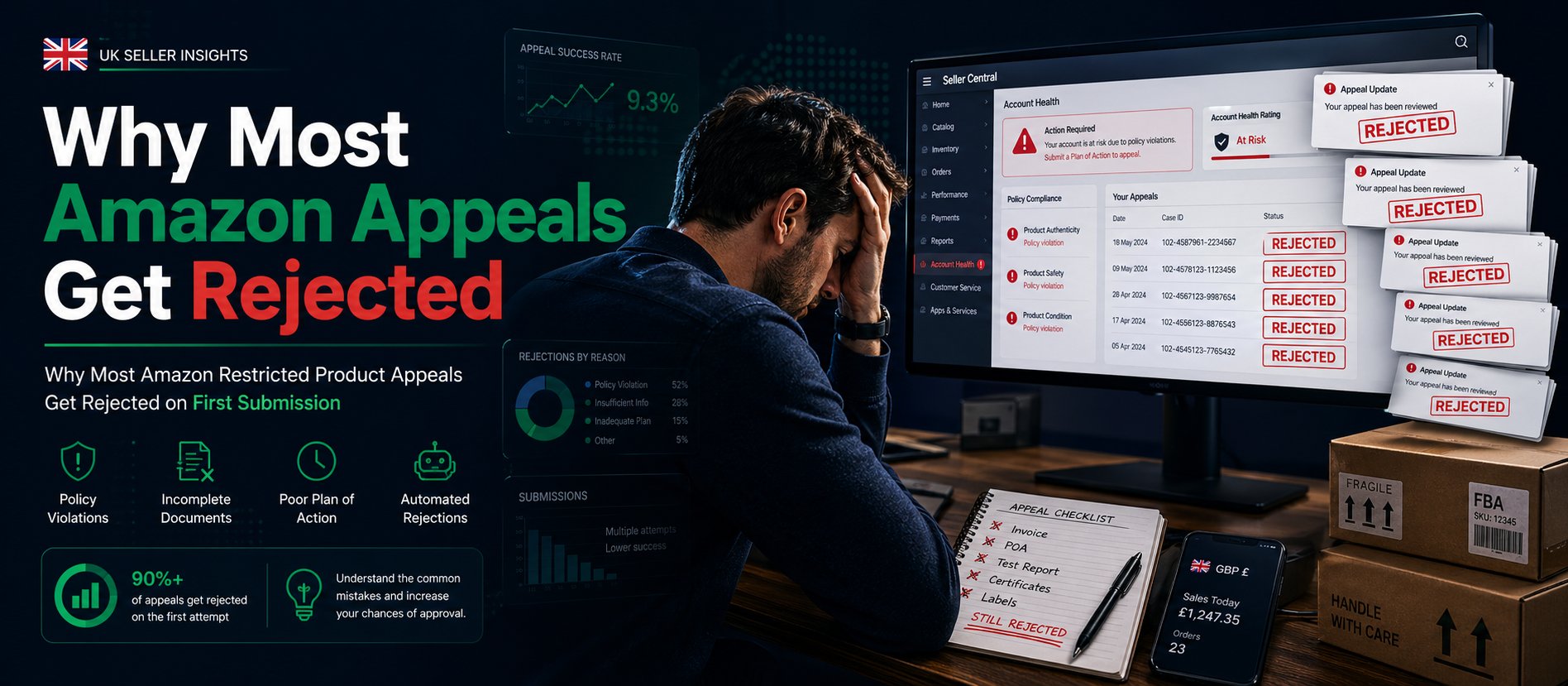
If you have just had a restricted product appeal rejected, you are not unusual. The rejection rate on first-submission appeals is high, and most sellers do not realise why until it is too late.
Many UK sellers approach a restricted product violation in good faith. They read the notice, write a polite explanation, attach what feels relevant, and submit. The response often arrives within 48 hours: another templated rejection, often using almost identical wording to the original notice. Frustration grows, a second appeal is fired off, and the cycle continues.
Each rejection makes the next appeal harder. By the time many sellers seek specialist help, they have already submitted two or three flawed responses, and the case has become significantly more difficult to resolve.
Understanding why first-submission appeals fail so often is the first step in avoiding that trap.
Amazon's appeal review process is largely automated
One of the most misunderstood aspects of Amazon's restricted product enforcement in 2026 is the role of automation. Many sellers assume their appeal is read by a human reviewer who weighs context, intent, and explanation. In reality, the first stage of review is almost always handled by automated systems.
These systems do not assess intent. They scan for specific signals: the structure of your appeal, whether key compliance language is present, whether your supporting evidence matches an expected format, and whether the listing data itself has been corrected to remove the original trigger.
If those signals are missing, the appeal is rejected before a human ever sees it. The reply you receive often appears templated because it is. Your appeal never reached a person.
The most common reasons appeals get rejected
From reviewing hundreds of restricted product cases, certain patterns appear again and again. These are the structural reasons most first-submission appeals fail.
1. The appeal addresses the wrong issue
Amazon's notice often does not state the actual underlying concern. A seller may receive a generic message saying their listing has been flagged as a restricted product, but the genuine trigger could be a single word in the title, a phrase in the bullet points, an image element, an old catalogue value, or a compliance signal tied to the brand's history.
Most sellers respond to what the notice appears to say rather than what Amazon is actually reacting to. Without identifying the real trigger, no appeal will be accepted, no matter how well written.
2. The submission lacks the right corrective and preventative actions
A successful appeal generally requires three elements: a clear acknowledgement of the issue, a corrective action, and a preventative action. These must be specific and demonstrate that the underlying cause has been addressed, not simply explained.
Vague language such as "we will be more careful in future" or "we have reviewed our listings" is one of the strongest indicators to Amazon's systems that the appeal is templated. These phrases trigger near-automatic rejection.
3. The listing was not actually fixed before the appeal was submitted
This is one of the most common and most damaging mistakes. Sellers submit an appeal explaining what they will fix, without first making the changes to the live listing. Amazon's systems often check the live listing data when assessing the appeal. If the original trigger is still present in the title, description, or back-end attributes, the appeal is rejected automatically.
4. Supporting documentation is missing or wrong
Restricted product cases often require specific supporting documents: lab reports, certificates of analysis, supplier invoices, ingredient declarations, regulatory approvals, or category-specific compliance proofs. The exact requirement depends on the product, the category, and the nature of the flag.
Submitting the wrong document, or no document at all, usually leads to immediate rejection. Submitting too much irrelevant documentation can also flag the appeal as low-quality.
5. The tone or structure flags the appeal as templated
Amazon's review systems are increasingly capable of detecting templated, copy-pasted, or AI-generated appeal text. Certain phrasing patterns, generic opening lines, and standardised structures trigger flags before the substance of the appeal is even considered.
Many of the templates available online have been used so widely that they are already known to Amazon's systems. Using them lowers the chance of a successful appeal, regardless of the underlying merits of the case.
Important: Each rejected appeal makes the next one harder. After two or three rejections, the case may be flagged for additional scrutiny, and some categories will move toward permanent restriction. The first submission is the most important.
Why generic templates rarely succeed
A common starting point for sellers is searching online for a "Plan of Action" template. These templates were once useful, but in 2026 their usefulness has dropped sharply.
Amazon's review systems have become more sophisticated, while the templates available online have remained largely unchanged. The most-shared templates have effectively become signatures: their phrasing, structure, and order of sections are recognisable to the automated review tools as low-effort submissions.
Even more importantly, no template can address the specific cause of your particular case. Restricted product violations are nuanced. Two listings may receive identical-looking notices, but the actual trigger can be entirely different. A template addresses neither.
Not sure what is actually triggering your case?
Our £79.99 Quick Review identifies the likely root cause and the recommended next step within one business day. Credited toward a recovery package if you upgrade within 7 days.
Start a Quick ReviewThe hidden cost of repeated rejections
Most sellers focus on the immediate revenue loss when a listing is suppressed. The hidden cost is often greater.
Each rejected appeal typically extends the recovery timeline by several days. During that period, organic ranking continues to decline, and competitor listings absorb the search visibility your product previously held. By the time a listing is reinstated after multiple rejections, the route back to its previous performance can take weeks of additional advertising spend and rebuilt sales velocity.
There is also a more serious risk. Repeated rejections can move a listing into a category of cases that receive additional human review or escalated scrutiny. In some categories, repeated failed appeals can lead to permanent restriction, removal of related ASINs, or wider account-level concerns.
When you should not appeal alone
If any of the following apply to your situation, a self-submitted appeal carries significant risk:
- Your first appeal has already been rejected
- The notice is generic and does not identify a specific trigger
- Your product is in a regulated or higher-risk category
- You have submitted templated text or AI-generated content already
- Multiple ASINs in your account have been flagged
- The commercial impact of continued downtime is significant
In any of those situations, the cost of a second wrong submission usually outweighs the cost of specialist support. The risk is not just continued downtime, it is the potential for permanent restriction.
What a specialist review changes
A specialist review focuses on what most self-submitted appeals miss: the actual trigger. That requires a structured assessment of the listing data, the notice content, the product category, the regulatory context, and the wider account history. From there, the appeal can be drafted to address the specific concern Amazon's systems are reacting to, in language and structure those systems are designed to accept.
The difference is rarely about persuasion. It is about precision. The right words, the right documents, and the right order, addressing the real underlying issue.
For sellers who have already had an appeal rejected, this difference is often what turns a stalled case into a resolved one.